Repair

Let’s Refurbish a Van – Part 8: Hood Scoops (By Andy)

A post by Andy

{Modified the title theme some. We think of ourselves much more as a big van than a small RV. I now want to start prefacing this and future posts to be more representative of our self-image.}

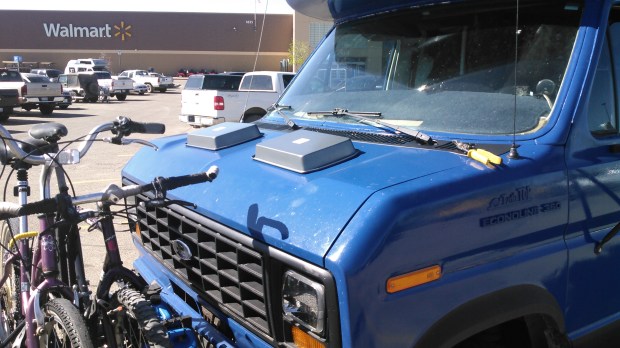
So, to the meat of the subject. I just finished our hood scoops! Why did I make hood scoops? Well, for one, they look pretty cool and I needed a prominent place to put my new go-fast emblems that I ordered from Amazon.

KIMG0530

Mainly, we are trying to get as much power out of the engine so we can get our heavy old self up the high steep hills. In that vein, I have been playing with the spark timing, carb mixture, and intake airflow. By tweaking and adjusting these parameters we are working to get the most power and efficiency out of our old engine. Specifically, advancing the timing can get the engine to produce more power, but too much spark advance causes engine problems—pinging and preignition. If the engine is cooler, one can run with more advance. Another way to look at it is that with a given timing advance, if the engine and intake air get hotter, then the timing is too far advanced.

Maybe a side note about my “go-fast” emblems. Car companies try to sell cars. Sometime fancy cars come with racing stripes, cool graphics, and badges on the side about engine stuff. A joke among car people is the question “How much horsepower do the stripes add?” The answer is, of course, none. But… they do look cool. Look around, they are everywhere: M3, AMG, Hemi, 440, HiPo. The only thing the badge or stripes could actually do is add an immeasurably small increase in drag, or some unneeded paint weight. They are simply for the people in the car next to you. All the same, they look sporty, so I bought some that state the displacement of our engine and say it is “High Performance”. What I’m saying here is they do nothing, but they truly do look great!

So, I wanted more air to get in and out of the engine compartment to cool the engine, and have the air flowing into the air cleaner be as cool (and dense) as possible. To make sure I had an understanding of the pre-hood-scoop environment, I first taped the probe end of my digital temperature gauge to the air cleaner. Over a few weeks in different driving conditions and different altitudes, we took notes about the temperature measurements of the air cleaner and air filter. You can see the wire to the probe, and the tape holding it in one location.
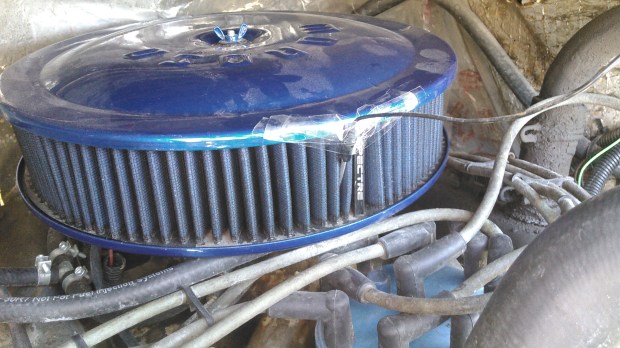
KIMG0451

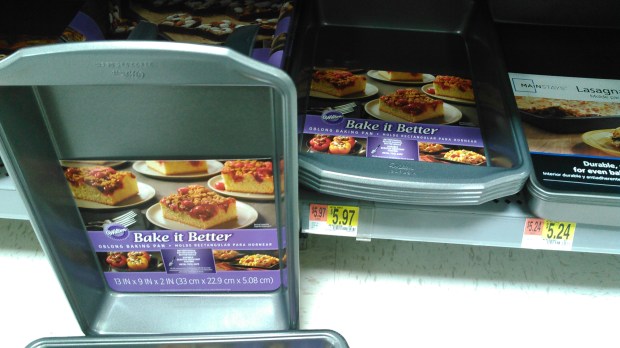
Overall, we are in the 150º–160ºF range under the hood after the engine gets warmed up and when the ambient temperature is in the 70º–80ºF range. So, to get more outside air in and more inside air out we need some kind of venting. I looked online, and $50+ plastic vents and scoops can be found, but they were not really van-sized, and seem flimsy. Metal ones can also be found, but are more expensive, and again, really don’t fit. Apparently there is an untapped market of people who want to mod 1985 Ford vans! (Investors be wary—the market may be small.) I finally hit on the idea that rectangle cake pans are about the size I wanted, and they are inexpensive, and they are made of metal designed to withstand 500ºF+. Going with this thought, while we were camping in El Malpais National Monument, I made some cake pan-sized cardboard mockups and spray painted them with a blue that I had.

Test fitting…

I thought that looked good, so a few days later when we were in a town, we got some cake pans.
KIMG0454

KIMG0455

One morning, a few weeks later, when we where camping at the Great Salt Lake, I got out the pans, tin snips, sandpaper, and primer, and got to work remaking our sweet cake pans into even sweeter performance hood scoops (please note the word play).

Here they are.

Test fitting.

We stashed them away for a bit and traveled onward. Another week later we had a free day while visiting our friends the Higdems in Kimberly, ID. I measured, moved, marked, measured, and measured and marked again. Then I started drilling holes in the hood.

Lots of little holes now!

After fitting and drilling the mounting holes, I now knew what piece of the hood (bonnet, for any Brits out there) to cut out. Out with the jig saw.

Another side note here: When putting the Turtle together, we set ourselves up with a few DeWalt cordless tools and the battery charger that plugs into a 12V cigarette lighter. The tool charger is now wired to our solar-charged batteries, so we are using the sun’s energy to drill, cut, and modify our hood. It feels fun to know that when working on projects such as this!

For the final install, I put down a small bead of RTV sealant, aligned the scoops, and screwed in the 6 screws per scoop that I had already pre-drilled. After the RTV cured a bit, I got out our boat paint and went at it.

Included above is, obviously, a photo of what Scout and Gracie were doing at the time. A few days later, at Dave and Ryann’s place, I added more RTV to smooth the transition and put on more paint to finish it all off.

All finished now, after the last painting and with the great go-fast badges installed.

We should call this the conclusions section of the post, for you science people out there. Well, they have been on now for a week, and we don’t move fast, so we have only driven a few hundred miles. We will need to collect more data, but so far the maximum under-hood temperature we have seen in 135ºF, and most of the time it has been in the 100º-120ºF range (and we are actually in hotter weather than when we took our non-hood scoop measurements). We have also driven through crazy heavy rain and, as expected and hoped for, the small amount of water that enters through the scoops has no adverse effects on the engine. Generally, a pretty solid success, and I have since advanced the ignition timing just a bit with no pinging.

Oh, maybe a cost breakdown. The sum total of the cake pans, primer, quantity of screws, RTV, and paint used is less than $20. The go-fast badges were $11 each. Dave suggests I sell it as “The whole project was less than 45 dollars.” I think I shall adopt that tract!

All that for less than 45 dollars!!!
A Broken Turtle Tale: Reserve, NM

In the last post, Andy itemized all our break-downs, according to the definition of breaking down that we’ve agreed upon. The final line item in that list was a break-down in Reserve, New Mexico which we mentioned we’d discuss further later. It’s not so much a story about what went wrong, though that’s exciting too, but about a lucky break in where we broke down and how wonderful it is to be reminded of how kind people are.

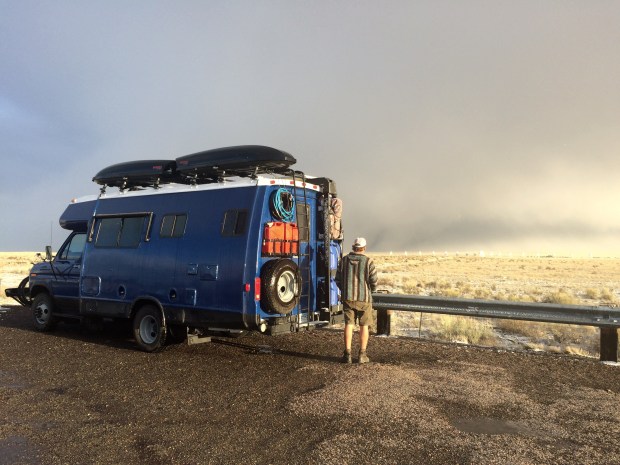
The story begins as we left Silver City from the Gila Cliff Dwellings. It was a stunning drive.

IMG_1854

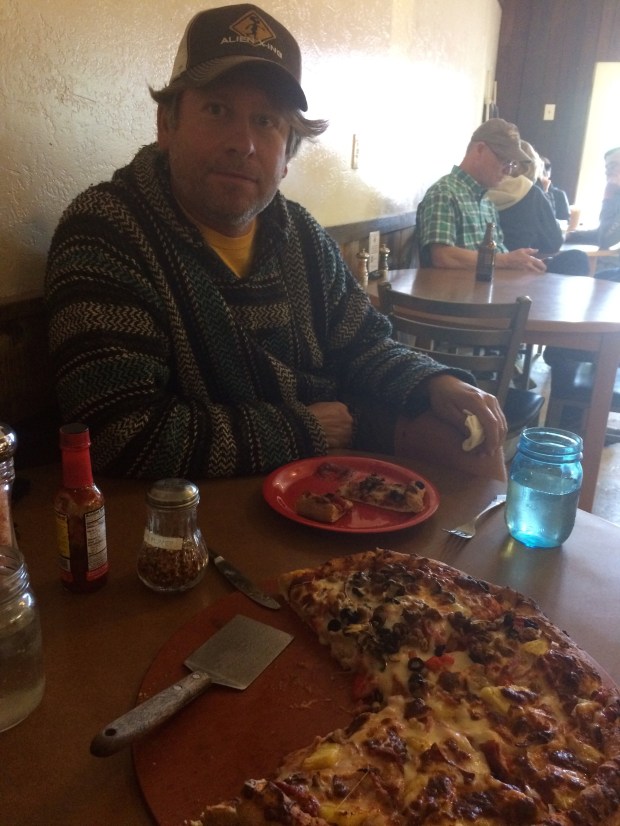
Andy had woken up that morning from delicious dreams of pizza, so we made it the daily goal to find ourselves a slice. As we passed through Reserve, NM we saw The Adobe Cafe had a flying banner advertising pizza, so we took it as a sign and went in. The pizza did not disappoint!

IMG_1862

We wrapped up our remaining slices and got back in the Turtle, started it up. . . and that starter just kept starting and turning over and making crazy sounds, and continuing to start even after Andy pulled the keys out. It was probably three minutes we spent panicking and looking at each other with saucer eyes and running around trying to figure out what to do, but both of us agree it felt like twenty before the starter finally died. We got out, and I popped the hood and began investigating. (Yeah, just kidding of course—Andy did that.) My job was to chat with the friendly locals who came over to make sure everything was all right.

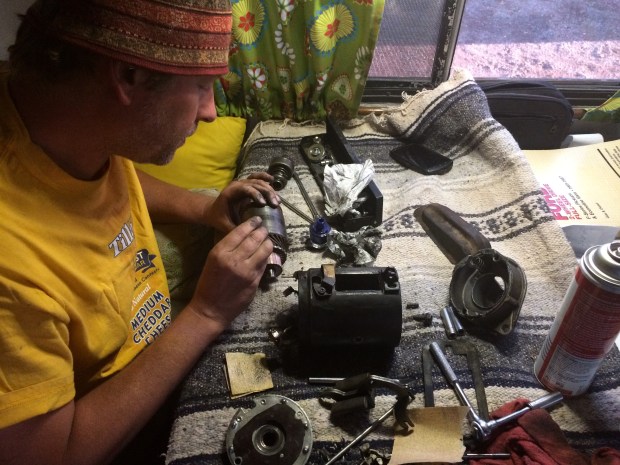
Andy here. What I suspected was happening, and what we finally concluded happened was this: When you turn the key to start, a little electrical current is fed to the started solenoid. The solenoid is a switch that then supplies a large current from fat wires from the battery to the starter (an electric motor), that then turns over the engine. The little solenoid switch got stuck in the connected position, so even after turning the key back, it was still making the connection to supply power to the starter. Starters are not designed to run for long, so the starter overheated, something important inside melted, and it died. To fix the problem, we then needed a new solenoid switch, and a new starter. Took less that 30 minutes to fix, once we got the right parts. We actually carry a spare starter and solenoid with us now…

And I’m telling you, the whole town of Reserve rallied together to help us out! People were driving home to see if they had spare starters, directing us to the auto shop down the road, checking back on us after attending the elementary school play their kids/grandkids were in that evening, and generally just offering any assistance they could. It was really encouraging. Because it was Friday, the shop wouldn’t be able to get parts in until Monday, so we thought we might be marooned for a few days. As a last resort, Andy did his best to revive the patient inside out of the rain, but the thing was D.O.A.

IMG_1867

IMG_1870

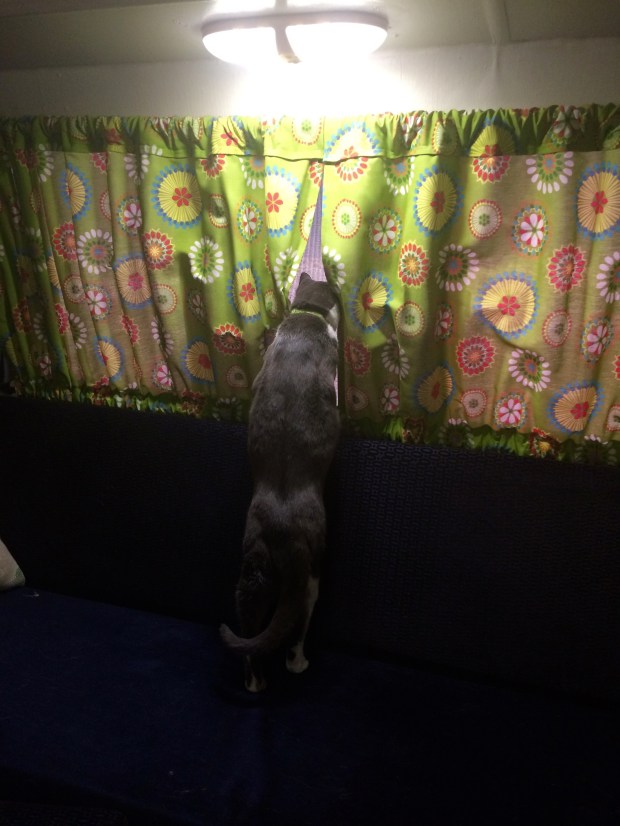
In the meantime, Gracie kept us apprised of the goings-on in the neighborhood.

IMG_1894

We met a local who coincidentally is from my hometown of Billings, MT. He offered to take Andy to the nearest town the following day to pick up a starter in Springerville, about an hour away. We were saved! We joined him at the local tavern for a beer and had a great time. Everyone there expressed concern for our stranded state and offered whatever help they could provide for us. But luckily, we had Craig. The next day he arrived to pick up Andy, and the two of them got the part, Andy installed it, and we were all set to go. Thanks Craig! You really saved the day!

We’d also like to thank the entire town of Reserve who made us feel welcome and not at all up that proverbial creek. At any given moment we had a handful of people on call, doing whatever they could to help us out. We had a lovely stay, and if we’re ever in the area we’ll definitely be back!

A Postscript Involving Pie: 

Due to the delay, we knew we were cutting it close if we were going to make it to the destination I’d pinned on our calendar three months ago and had been talking about ever since: an actual town called Pie Town, NM. Can you believe it? It’s a tiny little town with just a few shops, three of the four of them pie shops. And if you’ve met me you know how much I looooooove pie. I couldn’t wait.

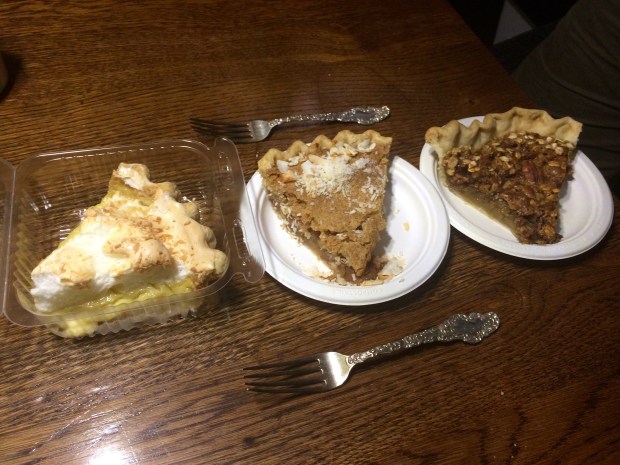
Unfortunately by the time we reached Pie Town, all the shops had just closed. I was pretty bummed out. As we drove through town, we noticed that Pie-O-Neer Pies had cars parked out front, so we pulled in, but the Closed sign was in the door and I was re-bummed. Then just as we began to back out, a petite smiling woman in a stylish hat popped out of the door and shouted to us, “Do you want pie?” We said YES! She said they only had three slices left, but we could come take a look. We said we’d take the lot, and they even threw in an extra slice for us. It was a very glorious day for me. We took them to go, and I waited impatiently for us to reach our evening destination outside of the Very Large Array. We found a perfect spot at a turn-out right by the entrance road.

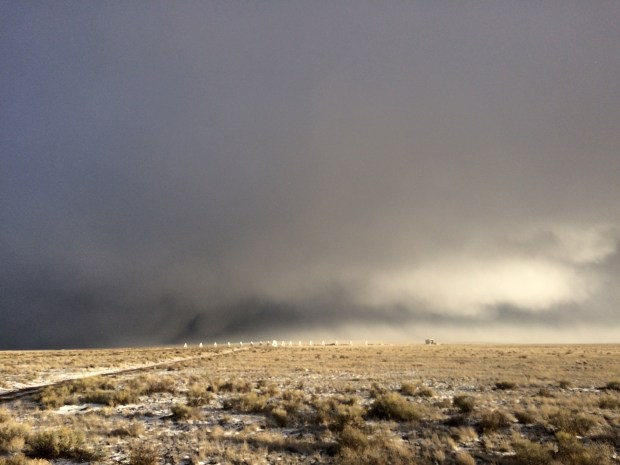
If you look in this picture, you can barely make out the VLA on the horizon. (It looked much closer in person.)

IMG_1906

IMG_1899

Then we ate pie!

IMG_1898

We ate them sampler-style, and loved all three. We had enough leftovers to enjoy two more dessert occasions as well.  We’ll definitely drive out of our way to return to Pie-O-Neer Pies in the future. What a treat!

So although reading the list that Andy put together may seem like a series of unfortunate events, they all make for great stories, and some of those stories even end in pie.

Turtle Broke Down! (By Andy)

A Blog Post by Andy:

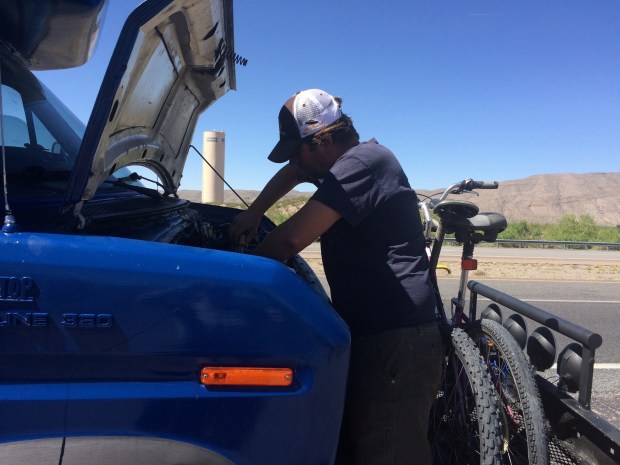
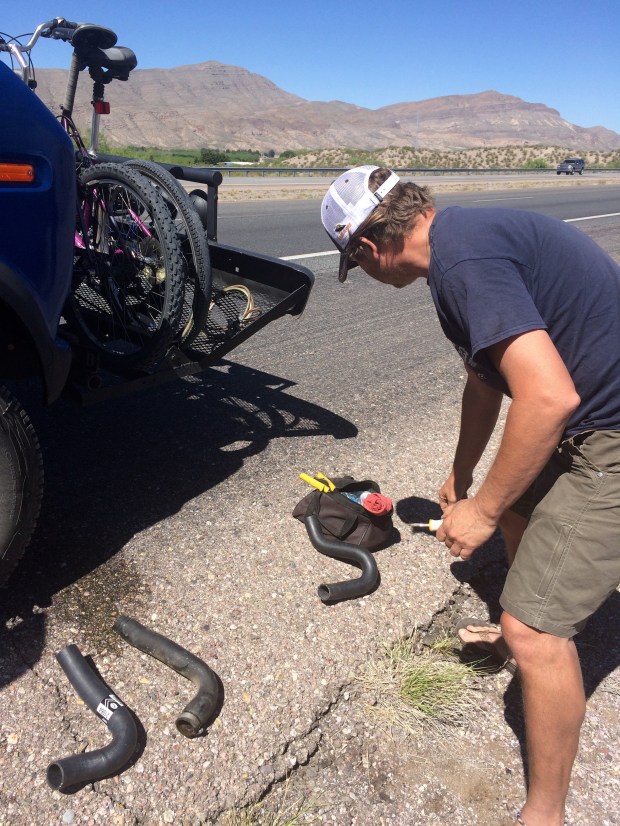
About a month ago, we left Las Cruces, New Mexico at a decent time, as we were wanting to get a good start on the 40-mile drive to Hatch, and get there well before 11:30. Should be a breeze. After maybe 15 minutes on the highway I noticed the temperature gauge go above the middle. I like to watch gauges—it’s a hobby. And it continued to go up. I thought I could smell a little antifreeze. And the gauge was still going up. The gauge went far to the right—to the max—so I slowed and pulled to the shoulder. At that point, the white smoke was billowing, billowing, billowing out from under the hood, and the sweet smell of antifreeze was in the air. (The steam actually soaked the carpet on the passenger side after we opened that door.) Did not take the time to snap any pictures at this point, but I jumped out and got the hood open to find:

IMG_1363

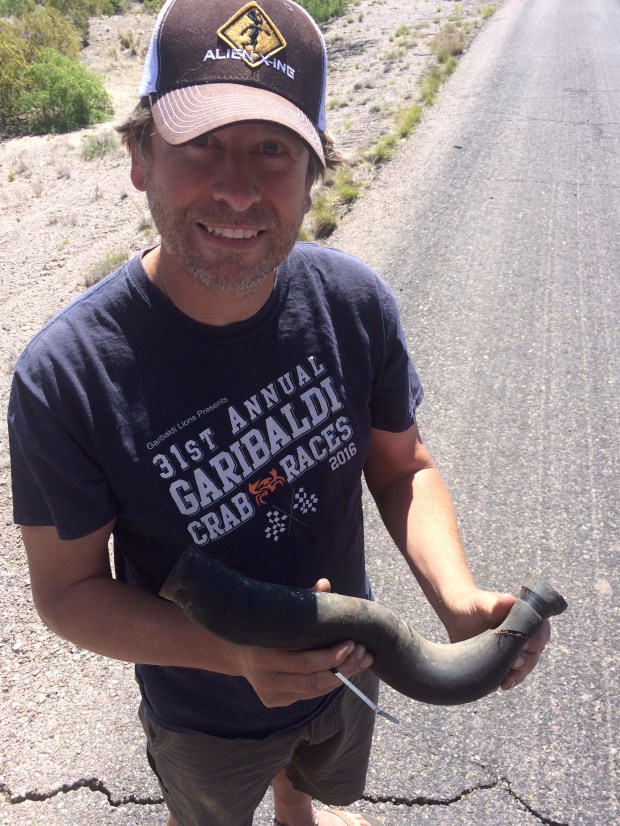
The top radiator hose had ripped open and emptied the contents of the radiator onto the hot engine. Quite a scene. After identifying the problem, Amy asked, “So what do we do?” I replied, “Well, I’ll climb up to the rocket boxes, get the spare hose, get some tools out, let the engine cool for a minute, install the new hose, refill the radiator with water from our blue jugs on the back, and we’ll continue to Hatch.” That is why I look happy in the picture!

IMG_1359

IMG_1354

Anyway, in 20 minutes we were back on the road. Pretty pleased with that! And, we made it to Hatch to have a pair of the signature green chile cheeseburgers from Sparkys—we have agreed that it is one of the best burgers we have ever had!

Anyway, that’s just a short day-in-the-life. It did spur us to revisit the following conversation. . .

We had a bit of a debate about what it means to “break down”. I had thought it meant that we had to have a tow truck involved. Amy thought it meant having to pull off the road due to car trouble that prevented the Turtle from operating on its own. After some talk, we decided that a break-down shall be defined as an unforced stop or non-start event that would cause someone who does not work on cars to need to call for help. With that definition, here are a few other break-downs we have had:

  • Bend, Oregon: Ignition system failure that took a few days to fix (mentioned in a prior post).
  • Driving toward Montana from Idaho the engine died. This was related to the Bend electrical problem, that I temporally fixed on the roadside, and made a lasting repair later.
  • Driving from Bozeman to Billings, MT: A/C compressor seized, causing the belt to have “a few hot spots”. In layman, that is black smoke and melting, burning rubber. Cut away belt and cooled the hot spots, and got back on the road. (Amy’s note: Andy tried to minimize this event by saying it was “just a few hot spots”. . . I saw the firedrops falling steadily from under the hood and now whenever he describes things like “a few hot spots” or “just some sparky bits” I have a good grasp of the level of danger we’re dealing with. Andy is a known under-exaggerator.)
  • Billings, MT: Hard start, then flooding, then backfire, then small engine fire. Got it cleaned up, and started after some fiddling.
  • Billings, MT: Old carb started flooding crazy, and would die if the RPM was slow, so it was a stressful two-footed drive to Bozeman (one foot on the gas, one on the brake), trying to keep the RPM’s high enough, with a lot of Neutral to Drive shifting at stops. Installed a sweet new Holly Street Avenger carb after that.
  • Bozeman, MT: battery overcharging and stuff…
  • Spearfish, SD: Could not start. It was cold, so I got out some starting fluid. The fuel line to the carb loosened and leaked, and trying to get it running ultimately ended with the fire extinguisher. Got better hose clamps and fixed it all up the next day.
  • Somewhere in Montana, pulling a long, steep hill the engine would seem to starve of fuel and putter. Had to pull over, and rev the engine with no load to refill the carb bowls, then get back on the road. At least that what we think caused the problem. We finally made it over the pass.
  • Others, including an overnight stay in Reserve, NM that was more vacation than stranding. Details to follow.

Amy’s Note: Andy felt pretty pleased that in the last year and a half, by his definition, we’d only “broken down” once. When we discussed the issue and I asserted that by most people’s standards we’d broken down many times, I have to admit how pleased I am that he doesn’t conform to other people’s definition of breaking down, since he is Boy Scout Level prepared to deal with any issues that arise. He keeps radiator hoses on hand, for dog’s sake. We’ve never felt hopeless, despite the amount of smoke and fire flying out of the engine.*

*Family members, please note that I am a serial exaggerator, but also that things have gone wrong as things can do, because our trusty Turtle is an old one, and still we are mobile and safe and continue to move down the road. Andy’s got it under control. 🙂